Day 7 Fasting & Prayer Encouragement

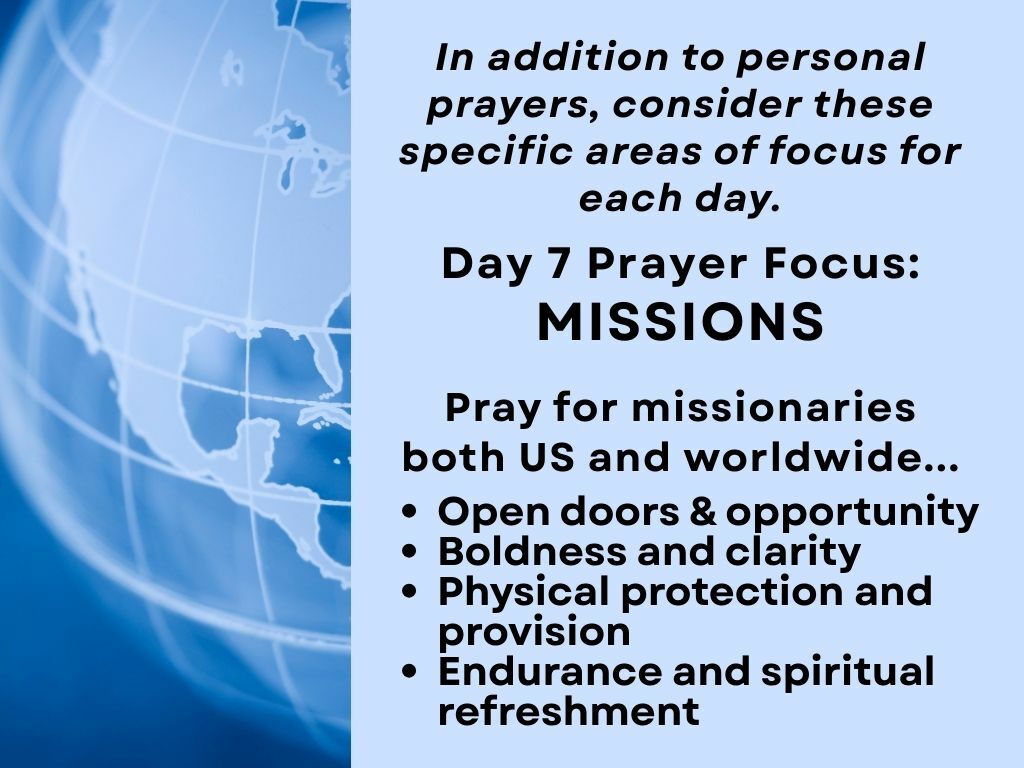
Each day during the fast, there will be a set prayer focus in addition to our personal prayers.
Today our prayer focus is Missions.
-
"Open Doors" and Opportunity (Colossians 4:3)
-
Boldness and Clarity (Ephesians 6:19)
-
Physical Protection and Provision (Philippians 4:19)
-
Endurance and Spiritual Refreshment (Galatians 6:9)
An encouragement from Pastor Hayes:
Isaiah 58:3 ‘Why have we fasted,’ they say, ‘and you have not seen it? Why have we humbled ourselves, and you have not noticed?’
Before the people of Israel and Judah were carried off into Babylon, they were facing incredibly difficult circumstances. Bitterness had grown between the tribes. Harvests were failing. Droughts had dried up wells and springs. It was a hard and discouraging time to be a Jew. And Scripture makes it clear—these troubles were the result of their own spiritual failures.
So they decided to fast and pray, hoping to force God’s hand into helping them.
But God wasn’t moving.
The problem wasn’t fasting. The problem wasn’t prayer.
The problem was that the people wanted God to give them credit for external acts while ignoring the internal changes for which He was calling. They wanted to add the good work of fasting on top of the sinful patterns they refused to surrender. In other words, they hoped religious activity would cancel out spiritual disobedience.
God wasn’t impressed.
And the same temptation exists for us today.
We already know the things God is asking us to put aside. We know the areas of our lives that fall short of bringing Him glory. We can’t simply stop eating and assume that sacrifice alone makes everything right.
Fasting is not a shortcut. It’s not a spiritual trade. And it’s not a way to manipulate God.
Fasting is a personal sacrifice—laying down things we enjoy—to show God the seriousness of our desire to be closer to Him. And when closeness comes, clarity follows. When intimacy grows, strength increases.
As we draw nearer to Him, He gives us the keys to overcome the struggles we face—and to walk into the blessings He has already prepared for us.
True fasting doesn’t change God’s heart.
It changes ours.